
The best story hook generators in 2026 are dedicated creative writing and narrative ideation tools engineered to produce compelling opening lines, high-tension chapter starters, and suspenseful scene openers for fiction writers, novelists, essayists, and digital storytellers. Specialized desktop software like AtomicHooks provides narrative-specific frameworks, including in medias res openings, philosophical paradoxes, and emotional stakes analyzers, allowing authors to hook readers from the very first sentence without suffering from creative paralysis.
In this article
- What Is a Story Hook Generator and Why Is the First Line Critical?
- The Psychology of Narrative Openers: How Great Stories Captivate the Brain
- The 8 Essential Types of Story Hooks (With Deep-Dive Examples)
- Dedicated Story Hook Software vs Generic AI Chatbots
- AtomicHooks for Creative Writers: Features, Architecture, and Workflow
- Genre-Specific Story Hook Blueprints (Sci-Fi, Thriller, Romance, Fantasy, Horror, Non-Fiction)
- Crafting Mid-Book Chapter Hooks and Page-Turning Cliffhangers
- Anatomy of Masterclass Openings: Deconstructing Famous First Lines
- Story Hook Generation Tools Comparison Table
- Step-by-Step System: How to Draft, Test, and Refine Opening Lines
- Seven Fatal Opening Mistakes That Cause Readers to Put Books Down
- How High-Converting Hooks Drive KDP and Digital Book Royalties
- Final Verdict
- Frequently Asked Questions
What Is a Story Hook Generator and Why Is the First Line Critical?
A story hook generator is an AI-assisted creative software application designed to generate gripping opening sentences, premise teasers, chapter leads, and narrative entry points for novels, short stories, screenplays, digital memoirs, and brand case studies. In literary publishing and modern digital storytelling, the opening lines of a work carry immense weight. Readers on Amazon Kindle, bookstore browsers, literary agents, and online readers routinely make purchasing and reading decisions based exclusively on the first paragraph.
According to publishing industry benchmarks, over 70% of readers who sample a book's opening "Look Inside" preview on digital storefronts decide whether to purchase within the first 300 words. If the opening sentences fail to establish an immediate narrative tension, an intriguing voice, or a compelling question, the reader exits the preview and explores competing titles in the catalog.
For independent authors self-publishing on platforms like Amazon KDP and Gumroad, mastering the opening hook is directly tied to read-through rates and commercial success. To learn how to package and sell complete digital books, explore our step-by-step guide on how to write and publish AI generated eBooks in 2026. A dedicated story hook generator solves the blank-page dilemma by rapidly generating dozens of narrative angles from a basic premise, allowing authors to focus on deep character development and expansive worldbuilding.
Windows desktop tool with built-in creative writing frameworks, narrative tension scoring, and instant story opening generation.
The Psychology of Narrative Openers: How Great Stories Captivate the Brain
Human cognition is fundamentally wired for storytelling. Cognitive neuroscientists have long documented that when humans encounter an engaging narrative, neural coupling occurs, synchronizing the listener's brain activity with the teller's ideas. However, before neural coupling can occur, the writer must pierce through the reader's default state of inattention and mental fatigue.
Every legendary literary opening achieves four specific cognitive objectives:
- Disrupting Equilibrium: A powerful opening immediately demonstrates that something in the story world is unstable, broken, or unusual. Stability is uninteresting; imbalance demands explanation. When a normal pattern is shattered in the first sentence, the brain treats the anomaly as an urgent survival or informational priority.
- Opening a Cognitive Loop: The opening sentence poses an implicit question that can only be answered by continuing to read. When George Orwell opened 1984 with "It was a bright cold day in April, and the clocks were striking thirteen," the absurdity of a clock striking thirteen instantly opens an active cognitive loop that compels the reader forward.
- Establishing Unique Tone and Voice: Within ten words, the reader subconscious calibrates the author's personality, vocabulary, and narrative authority. A sluggish, passive opening signals an unpracticed writer, whereas a sharp, rhythmic sentence builds immediate trust.
- Setting Immediate Stakes: The reader must understand what the protagonist stands to gain or lose, even if the full scope of the world has not yet been introduced. Stakes create emotional investment and empathy.
The 8 Essential Types of Story Hooks (With Deep-Dive Examples)
Professional novelists and screenwriters draw upon distinct narrative hook archetypes depending on the genre and pacing of the story. Understanding these structural frameworks allows you to select the right generator settings for your project:
1. The In Medias Res (Action) Hook
This hook drops the reader directly into the middle of a high-stakes action scene or crisis without preliminary exposition. It bypasses mundane world setups and forces the reader to piece together the context from dynamic motion.
- Example: "The glass shattered across the kitchen tile three seconds before the silent alarm reached the precinct."
- Mechanics: Combines sudden sensory impact with a ticking clock constraint.
- Best For: Thrillers, crime fiction, action-adventure, and investigative journalism.
2. The Philosophical Paradox Hook
This opener presents a counterintuitive truth, controversial observation, or moral dilemma that challenges conventional thinking. It forces the reader to pause and evaluate the premise against their own lived experience.
- Example: "The easiest way to get away with murder in a small town is to make sure everyone agrees the victim had it coming."
- Mechanics: Provokes cognitive dissonance and introduces a dark moral ambiguity.
- Best For: Literary fiction, psychological dramas, and thoughtful memoirs.
3. The Vulnerable Confession Hook
The narrator breaks the fourth wall to admit a shameful secret, personal failure, or taboo realization. This creates an immediate feeling of intimate complicity between the reader and the protagonist.
- Example: "I attended my business partner's funeral not to mourn his passing, but to verify that he was truly in the casket."
- Mechanics: Establishes immediate emotional vulnerability and moral complexity.
- Best For: First-person mysteries, domestic suspense, and personal essays.
4. The Looming Threat Hook
An omnipresent, impending disaster is introduced with a ticking clock, establishing high urgency and existential dread.
- Example: "The atmospheric scrubbers had twelve hours of oxygen remaining when the communications antenna snapped."
- Mechanics: Quantifiable physical countdown combined with a mechanical failure.
- Best For: Science fiction, survival fiction, and disaster narratives.
5. The Sensory Contrast Hook
Juxtaposes striking physical sensory details to create an evocative atmosphere and emotional mood that lingers in the reader's imagination.
- Example: "The smell of fresh lilac perfume could not completely mask the copper tang of fresh blood on the drawing-room carpet."
- Mechanics: Pairs an innocent, gentle fragrance with an ominous visual and olfactory violence.
- Best For: Historical fiction, Gothic mystery, and fantasy.
6. The Unreliable Narrator Hook
Signals immediately to the reader that the narrator's perception of reality is distorted, biased, or suspect, inviting the reader to become an active detective.
- Example: "They told the judge I imagined the footsteps in the attic, but ghosts do not leave muddy boot prints on the ceiling."
- Mechanics: Introduces institutional skepticism contrasted against tangible physical evidence.
- Best For: Psychological thrillers, horror, and surrealist fiction.
7. The World-Rule Exception Hook
Establishes a fundamental magical, technological, or societal rule of the setting, followed by an immediate violation of that rule.
- Example: "Every citizen received their soulmate designation on their eighteenth birthday, except for Julian, whose envelope was empty."
- Mechanics: Explains societal worldbuilding in a single clause and creates an instant outcast protagonist.
- Best For: Fantasy, dystopian fiction, and young adult speculative fiction.
8. The Comic Irony Hook
Uses dry wit, observational humor, or deadpan understatement to highlight the absurdity of a character's predicament.
- Example: "Being struck by lightning twice in a single afternoon was inconvenient; missing dinner because of it was unforgivable."
- Mechanics: Inverts logical priorities by treating catastrophic events as minor annoyances.
- Best For: Dark comedy, cozy mystery, and lighthearted contemporary fiction.
Dedicated Story Hook Software vs Generic AI Chatbots
While general-purpose language models can draft broad blocks of prose, they often struggle when tasked specifically with crafting memorable literary hooks:
- Overused Tropes and Purple Prose: Generic chatbots routinely rely on cliché starters such as "In a world where shadows lurk..." or "The sun dipped below the horizon as...". These lines feel manufactured and lack original cadence.
- No Tension or Syllable Cadence Analysis: General tools provide text without measuring the metric rhythm, phonetic punch, or curiosity quotient of the opening phrase.
- Lack of Niche Creative Frameworks: Dedicated tools come pre-configured with structural paradigms designed specifically for chapter starters, novel openings, and dialogue kickoffs.
- Cloud Latency vs. Native Desktop Speed: Running a dedicated desktop app on your Windows PC enables instant generation without monthly subscription fees or cloud rate limiting.
Writers who also manage multiple prompt libraries and storytelling assets can benefit from combining hook generators with dedicated organization tools, as detailed in our guide on the best AI prompts organizer for creators in 2026.
AtomicHooks for Creative Writers: Features, Architecture, and Workflow
AtomicHooks provides dedicated creative writing modules built specifically to generate opening lines, chapter transitions, and scene starters.
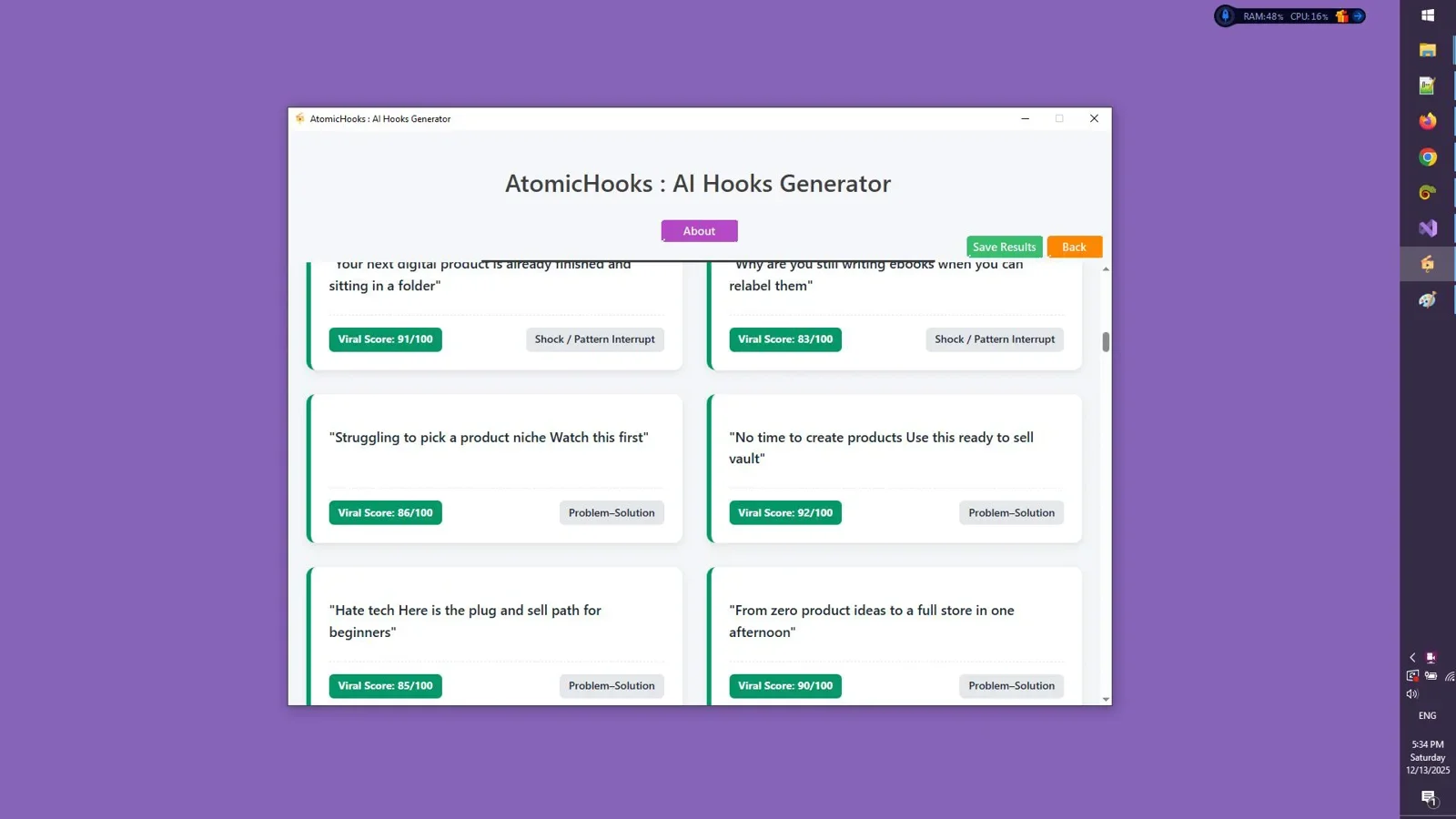
1. Narrative Framework Selector
Inside AtomicHooks, writers can choose from tailored storytelling modes, including In Medias Res, Mystery Teaser, Character Conflict, Dystopian World-Rule, and Poetic Contrast. Each mode adjusts the underlying algorithm to balance sensory details, dialogue, and pacing.
2. Predictive Curiosity & Tension Scoring
The software calculates a real-time tension rating for each generated sentence. It checks whether the line contains sufficient informational ambiguity to compel the reader forward while maintaining grammatical clarity and punchy rhythm.
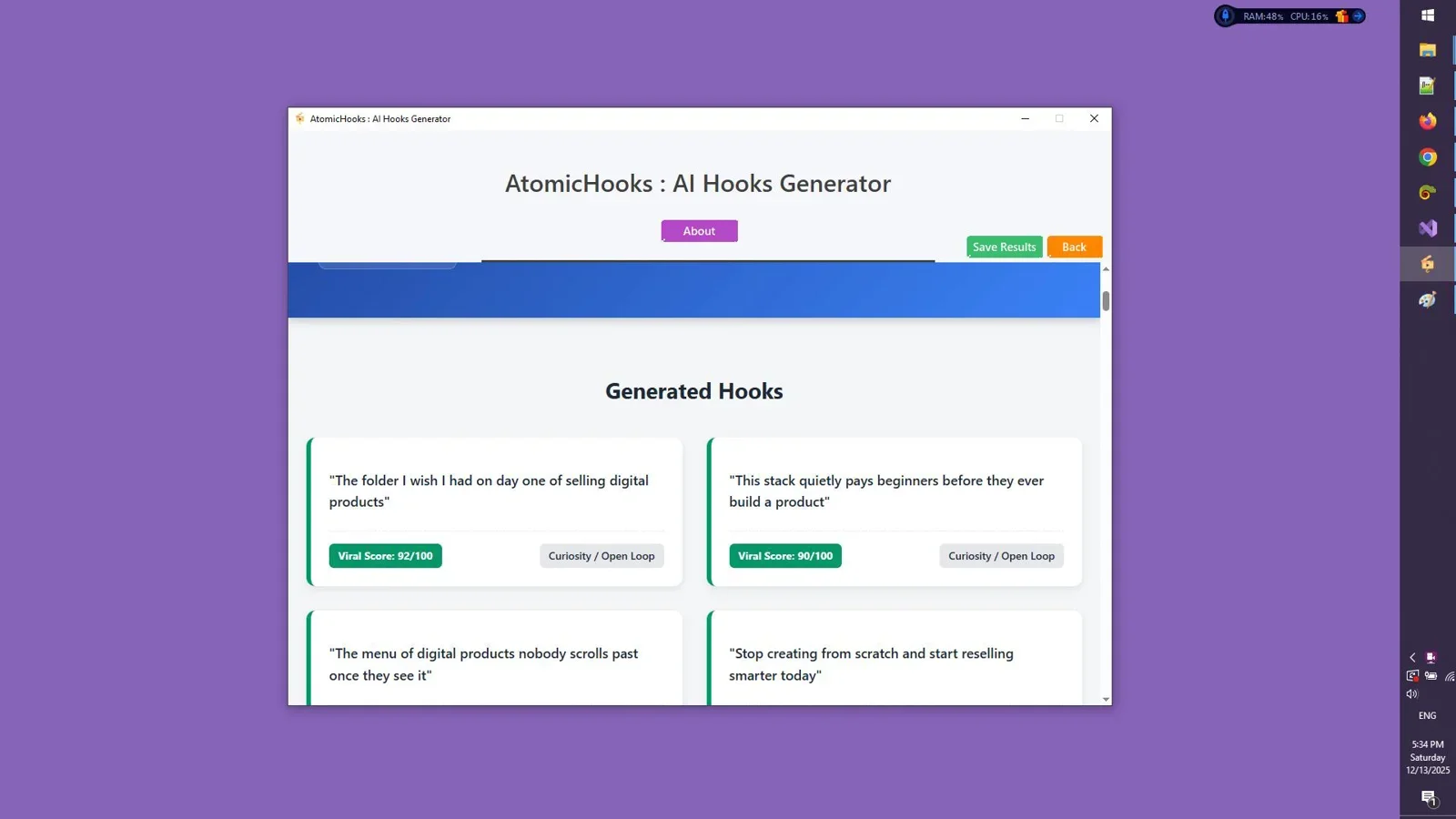
3. Offline Desktop Workspace for Authors
Because creative projects require absolute confidentiality, AtomicHooks runs entirely on your local PC. Your character outlines, worldbuilding notes, and unreleased manuscript drafts remain completely private on your hard drive.
Never get stuck on an opening chapter or scene transition again. Generate high-tension literary hooks on your Windows PC.
Genre-Specific Story Hook Blueprints (Sci-Fi, Thriller, Romance, Fantasy, Horror, Non-Fiction)
Different fiction genres require tailored opening mechanics to satisfy reader expectations. Here is how story hook frameworks adapt across six primary publishing genres:
1. Science Fiction & Cyberpunk
- "The synthetic neural link warned me of an impending cardiac arrest three minutes before the hacker took control of my hands."
- "In the Martian colonies, oxygen was traded on the stock exchange every morning at six sharp."
- "The deep-space salvage beacon had been broadcasting the exact same distress call for two hundred years after the ship had supposedly docked on Earth."
2. Crime & Psychological Thriller
- "Detective Miller knew the killer was left-handed the moment he saw how the bedroom door had been unlocked from the inside."
- "The ransom note arrived twelve hours before my daughter actually disappeared."
- "Everyone in the precinct believed the confession, except the officer who had planted the murder weapon."
3. Epic & Urban Fantasy
- "The iron gates of the citadel only opened when doused in royal blood, which explained why the high priest was looking at the apprentice."
- "Magic had been outlawed in the capital for three centuries, but the black market for enchanted matches was thriving in the alleys."
- "The dragon did not demand gold or cattle from the village; it demanded thirty minutes of conversation every solstice."
4. Romance & Contemporary Drama
- "Agreeing to be the maid of honor for my ex-fiancé's wedding was my first bad decision of the summer; letting his brother drive me there was the second."
- "We had divided the antique bookstore down the middle with blue masking tape, but our coffee cups kept crossing the border."
- "The contract clearly stated that our fake marriage would end after twelve months, but neither of us had read the fine print in clause nine."
5. Horror & Supernatural Suspense
- "The house had three mirrors on the ground floor, but none of them reflected the person standing in front of them."
- "We buried the grandfather clock beneath six feet of soil, but we could still hear it ticking beneath the floorboards every midnight."
- "The photograph was taken thirty years before I was born, yet there I was, standing in the back row with my eyes closed."
6. Narrative Non-Fiction & Biography
- "On the morning of October 14, 1962, a photo analyst named Richard Heyser looked at a strip of film that would bring the world within hours of nuclear annihilation."
- "When the laboratory doors were unsealed after thirty years of quarantine, the team discovered that the specimen container had been opened from the inside."
- "He had amassed three billion dollars before his thirtieth birthday, but on the night his company went public, he was sleeping on a cot in the server room."
Crafting Mid-Book Chapter Hooks and Page-Turning Cliffhangers
While the first line of Chapter 1 secures the initial purchase, opening and closing hooks on intermediate chapters maintain narrative momentum throughout the 80,000-word arc of a full-length book.
1. The Chapter Opening Anchor
Avoid starting middle chapters with passive weather descriptions or mundane transitions (e.g., "The next morning, Sarah woke up and had coffee"). Instead, start every chapter with an active micro-hook:
- A Shift in Perspective: "While Arthur searched the ruins, the courier was already halfway across the border with the decoded letter."
- An Interrupted Plan: "The escape plan had failed before we even reached the ventilation shaft."
- A Revelation of Consequences: "Three days after signing the treaty, the border villages were already burning."
2. The Micro-Cliffhanger Chapter Close
End chapters on unfulfilled expectations, unexpected knockings at the door, or sudden realizations to compel readers into the next chapter late into the night. An effective chapter cliffhanger does not require an explosion; it simply requires an unanswered question or a shift in leverage.
Anatomy of Masterclass Openings: Deconstructing Famous First Lines
To master the mechanics of hook generation, study how iconic literary authors structured their legendary opening lines to capture readers for generations:
1. Shirley Jackson: The Haunting of Hill House (1959)
"No live organism can continue for long to exist sanely under conditions of absolute reality; even larks and katydids are supposed, by some, to dream. Hill House, not sane, stood by itself against its hills, holding darkness within; it had stood so for eighty years and might stand for eighty more."
Structural Analysis: Jackson begins with an abstract philosophical premise regarding sanity and reality, then immediately personifies the architecture of Hill House as "not sane." This establishes psychological horror before any physical ghost appears.
2. Franz Kafka: The Metamorphosis (1915)
"One morning, when Gregor Samsa woke from troubled dreams, he found himself transformed in his bed into a horrible vermin."
Structural Analysis: Kafka employs extreme matter-of-fact understatement. Rather than describing a dramatic magical ritual, the transformation is treated as an accomplished fact upon waking, forcing the reader to accept the premise instantly.
3. Albert Camus: The Stranger (1942)
"Mother died today. Or maybe yesterday; I can't be sure."
Structural Analysis: In just ten words, Camus creates an unforgettable psychological portrait of Meursault. The emotional detachment regarding his mother's death immediately signals an alienated, unconventional protagonist.
Story Hook Generation Tools Comparison Table
The table below highlights key functional differences between dedicated desktop hook software, generic AI chatbots, and manual brainstorming:
| Feature / Criteria | AtomicHooks (Desktop) | Generic AI Chatbots | Manual Creative Writing |
|---|---|---|---|
| Literary Framework Variety | Pre-configured for 8+ narrative styles | Requires manual prompt engineering | Limited by individual memory and bias |
| Tension & Pacing Metric | Built-in algorithmic scoring | None | Subjective guesswork |
| Cliché Avoidance Engine | Filters out repetitive AI opening tropes | High recurrence of standard AI phrases | High writer fatigue risk |
| Manuscript Data Privacy | 100% private offline on Windows PC | Processed and stored on cloud servers | 100% private |
| Pricing Structure | One-time payment | Monthly subscription ($20 to $50/mo) | Hours of unbilled time |
Step-by-Step System: How to Draft, Test, and Refine Opening Lines
Follow this systematic 4-step creative workflow to produce opening hooks that stand out in crowded book markets:
Step 1: Extract the Central Conflict and Core Emotion
Identify the central dramatic question of your story. Are you writing about survival, betrayal, discovery, forbidden passion, or redemption? Your opening line must evoke the primary emotional tone of that conflict.
Step 2: Generate 20 Distinct Hook Variations
Input your premise into AtomicHooks and generate 20 variations across multiple frameworks (In Medias Res, Paradox, Threat, Sensory Contrast). Do not stop at the first acceptable line; allow the software to explore unconventional angles.
Step 3: Analyze Cadence and Eliminate Filler Words
Read your top five candidate hooks out loud. Eliminate passive verbs, unnecessary adverbs, and introductory preambles. Ensure that every single word delivers maximum sensory or cognitive impact.
Step 4: Conduct Blind A/B Testing with Beta Readers
Present your top 3 opening lines to a small group of beta readers or in an author newsletter poll without revealing which one you prefer. Ask them a single question: "Which of these three lines makes you want to turn the page immediately?"
Seven Fatal Opening Mistakes That Cause Readers to Put Books Down
Even talented authors make critical mistakes during the first few pages of a manuscript. Avoid these seven common pitfalls:
- The Weather Report: Starting with lengthy descriptions of clouds, rain, or the sunrise. Unless the weather is actively threatening the protagonist's survival, start with character action.
- The Mirror Exposition: Having the main character wake up, look into a bathroom mirror, and describe their hair, eye color, and physique. This is a notorious amateur trope.
- The History Lesson (Info-Dumping): Spending the first three pages explaining the political history of the fantasy realm or the technological specs of the starship before introducing a living character.
- The False Dream Opening: Beginning with an intense life-or-death crisis, only to reveal on page two that the protagonist was merely waking from a nightmare. Readers feel cheated by false stakes.
- The Unconnected Prologue: Writing a dramatic prologue featuring characters who die immediately and have no emotional connection to the main storyline.
- The Passive Dialogue Opening: Starting with greeting pleasantries such as "Hello, how are you today?" instead of diving directly into the core dispute.
- The Vague Abstract Monologue: Opening with philosophical musings about the nature of life that have no concrete physical grounding in the immediate scene.
How High-Converting Hooks Drive KDP and Digital Book Royalties
In digital book marketing on Amazon KDP, Apple Books, and Google Play Books, read-through rates determine both organic algorithmic ranking and Kindle Unlimited (KU) page-read royalties. When an author publishes a series, the conversion rate of Book 1's opening chapter directly dictates the lifetime customer value (LTV) of the entire series.
Consider the economic impact of hook optimization across a 5-book fantasy or romance series:
- Unoptimized Opening: 1,000 readers sample Chapter 1. 20% read through to the end of Book 1 (200 sales). 30% continue to Book 2 (60 sales). Total series sales: ~320 unit sales.
- Optimized High-Tension Hook: 1,000 readers sample Chapter 1. 55% read through to the end of Book 1 (550 sales). 50% continue to Book 2 (275 sales). Total series sales: ~1,250 unit sales.
A superior opening hook more than triples total royalties from the exact same initial marketing traffic, proving that the first 300 words are the most financially valuable real estate in your entire manuscript.
Final Verdict
Who should use this tool?
AtomicHooks is the premier desktop workstation for novelists, creative copywriters, screenplay writers, and indie authors who want to eliminate writer's block and craft gripping, high-converting opening hooks. With its dedicated narrative modes, predictive tension analysis, and offline privacy on Windows, it is an essential creative asset for serious authors in 2026.
Overall Rating: 4.9 / 5
Ready to Craft Story Openers That Readers Cannot Put Down?
Generate high-tension narrative hooks and chapter starters on your Windows PC today.
Get AtomicHooks →Direct one-time purchase with instant digital delivery.
Frequently Asked Questions
What is a story hook generator?
A story hook generator is an AI creative writing tool designed to create compelling first lines, scene openers, and chapter transitions that immediately capture a reader's curiosity and establish narrative momentum.
What makes an opening line compelling in fiction?
A great fiction hook disrupts equilibrium, introduces a cognitive loop, establishes a distinct narrative voice, and introduces immediate stakes without relying on passive exposition or cliché tropes.
Can I use a story hook generator for non-fiction and memoirs?
Yes. Non-fiction books, investigative essays, and personal memoirs benefit heavily from story hook frameworks such as sensory micro-scenes, counterintuitive data points, and vulnerable confessions.
How do I prevent my story openings from sounding like AI clichés?
Use specialized desktop tools like AtomicHooks that incorporate cadence checking and tension scoring, and always refine generated lines by reading them aloud, eliminating adverbs, and injecting specific sensory details unique to your characters.
Is my manuscript data kept private when using desktop hook tools?
Yes. Desktop software like AtomicHooks operates locally on your Windows PC, ensuring that your story outlines, plot twists, and drafts are never stored or logged on cloud servers.
Comments (0)
Leave a Comment